Stop Playing Board. Start Governing
elcome back to the boardroom, where agendas are long, attention spans are short, and strategic focus too often takes a backseat to endless committee updates and calendar trivia. If you’ve ever sat through a board meeting and left wondering if anyone in the room knows what governance actually means, you’re not alone. Let’s cut to the chase: many boards are too distracted, too reactive, and too wrapped up in operations to steer the ship with clarity and purpose.
Enter the Carver Method — it is not a magic bullet, but can be a strong dose of clarity in a world of mushy governance. Also known as Policy Governance®, Carver’s approach aims to solve one of the biggest problems in board leadership: the chronic confusion between governance and management. And let’s be real, that confusion isn’t just annoying — it’s damaging. It undercuts strategy, exhausts executive leadership, and leaves organizations adrift in a sea of well-meaning but directionless effort.
The Core Problem: Boards That Can’t Focus Strategically
As I mentioned in an earlier piece, too many boards live under the tyranny of the Pareto Principle — 20% of members doing 80% of the work. The few who carry the load often default to putting out operational fires because the board never really got clear on what its job is in the first place. Here’s the thing: most board members are smart, capable people. What they lack isn’t talent, it’s a framework. A framework that defines their role, channels their effort, and keeps them in the strategic lane. That’s where the Carver Method comes in.
Carver 101: Stay In Your Lane
The Carver model makes one big, revolutionary claim: the board's job is to govern — not to manage. That means setting the ends (the outcomes the organization is supposed to achieve) and the limitations (the guardrails for how staff can go about achieving them). It doesn’t mean approving every decision or micromanaging the ED’s to-do list. In fact, it explicitly warns against that. If boards adopted just that one idea — to get out of the weeds and into the why — we'd already be better off.
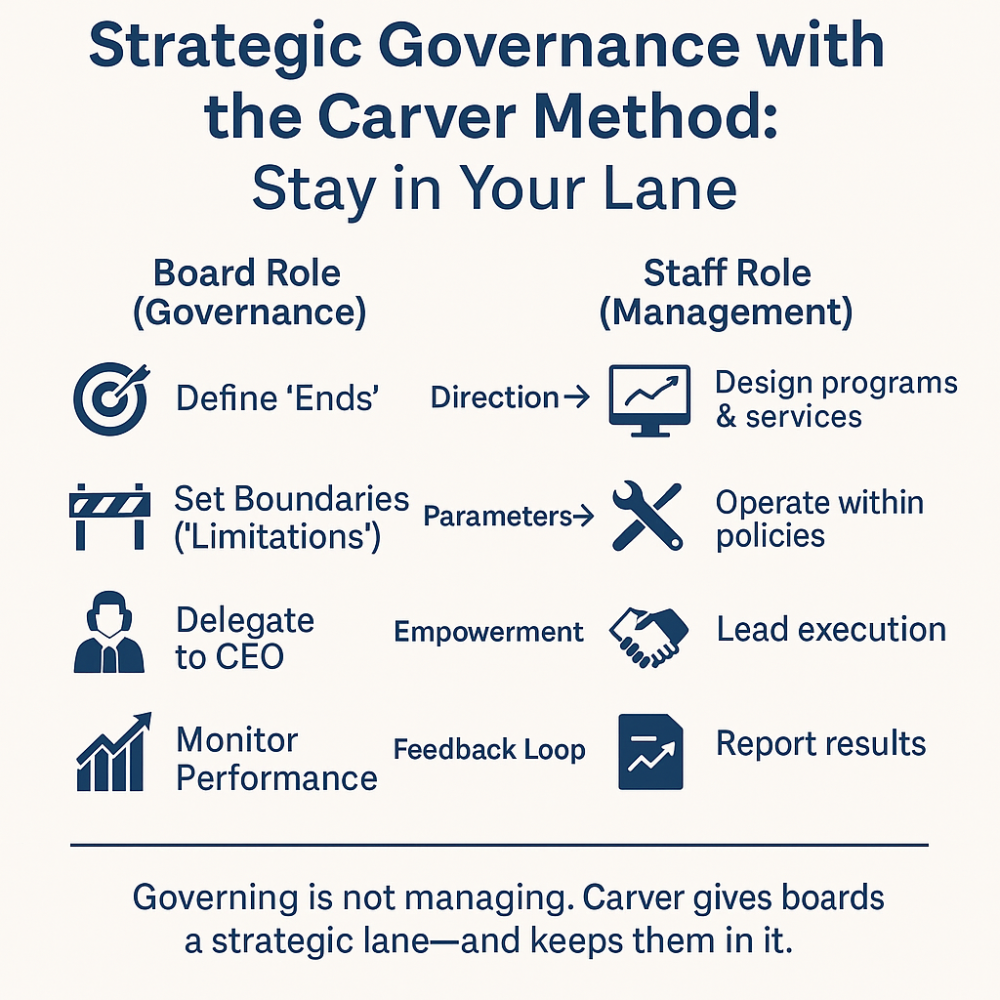
The Carver model gives boards four key jobs:
Define the desired outcomes (Ends).
Set boundaries (Limitations).
Delegate authority to the CEO.
Monitor performance relative to the ends and limitations.
Sounds simple, right? It is. But simple doesn't = easy. That’s why most boards default to comfort zones like budget line items and program updates instead of the real work: clarifying purpose, setting direction, and holding the organization accountable for results.
How This Connects to the Consult, Train, Coach Model
Let me bring it back to what I said in an earlier article — if you want a board to lead, you need more than a training. You need assessment, a focused workplan, and ongoing coaching. The Carver model gives that coaching effort some teeth. It sets a framework boards can actually be trained into.
Assessment: Use Carver’s framework to assess what the board is actually spending its time on. Spoiler alert: it’s probably not governance.
Training: Focus training on the distinction between “ends” and “means.” Most board dysfunction stems from not knowing which is which.
Coaching: Use real-time board scenarios to coach exec committees and full boards into staying in their lane — and doing it with clarity, purpose, and discipline.
Why Carver Is a Culture Change, Not a Compliance Tool
Adopting the Carver model is like switching from regular coffee to espresso. It’s concentrated, focused, and a little intense — but that’s exactly what many boards need. It demands a culture shift where the board stops being a performance audience and starts acting like a strategic compass. And yes, it’s going to be uncomfortable. People will resist. Some will miss their program updates. Others will struggle to give up control over the little things. That’s okay. You’re changing culture, not just protocols.
Bottom Line: Time for Grown-Up Governance
The Carver model isn’t for every board — at least not right away. It is for boards that are ready to get serious about leveling up governance. Ready to let go of the illusion that micromanagement equals engagement. Ready to focus on governing for outcomes, not babysitting process. If your board wants to go from “well-meaning but meh” to strategically sharp, this is a path worth exploring. Paired with a consult, train and coach approach, the Carver method can be the structural backbone that supports a real transformation in how your board leads.
It’s time to stop playing board and start governing.