How To Use A Guiding Narrative to Get Your Board Out Of Its Own Way
Nonprofit executive directors and board chairs know this moment all too well: Your board needs direction — badly — but the idea of launching a full-blown strategic planning process makes you want to fake a Wi-Fi outage. Consultant/facilitator fees. The months of meetings. The endless SWOTs that somehow say everything and nothing at the same time. All of it piled on top of an organization that’s already running lean and trying to actually do work. So here’s the question no one asks out loud: What if the problem is not that you don’t have a plan — it’s that planning has become the work?
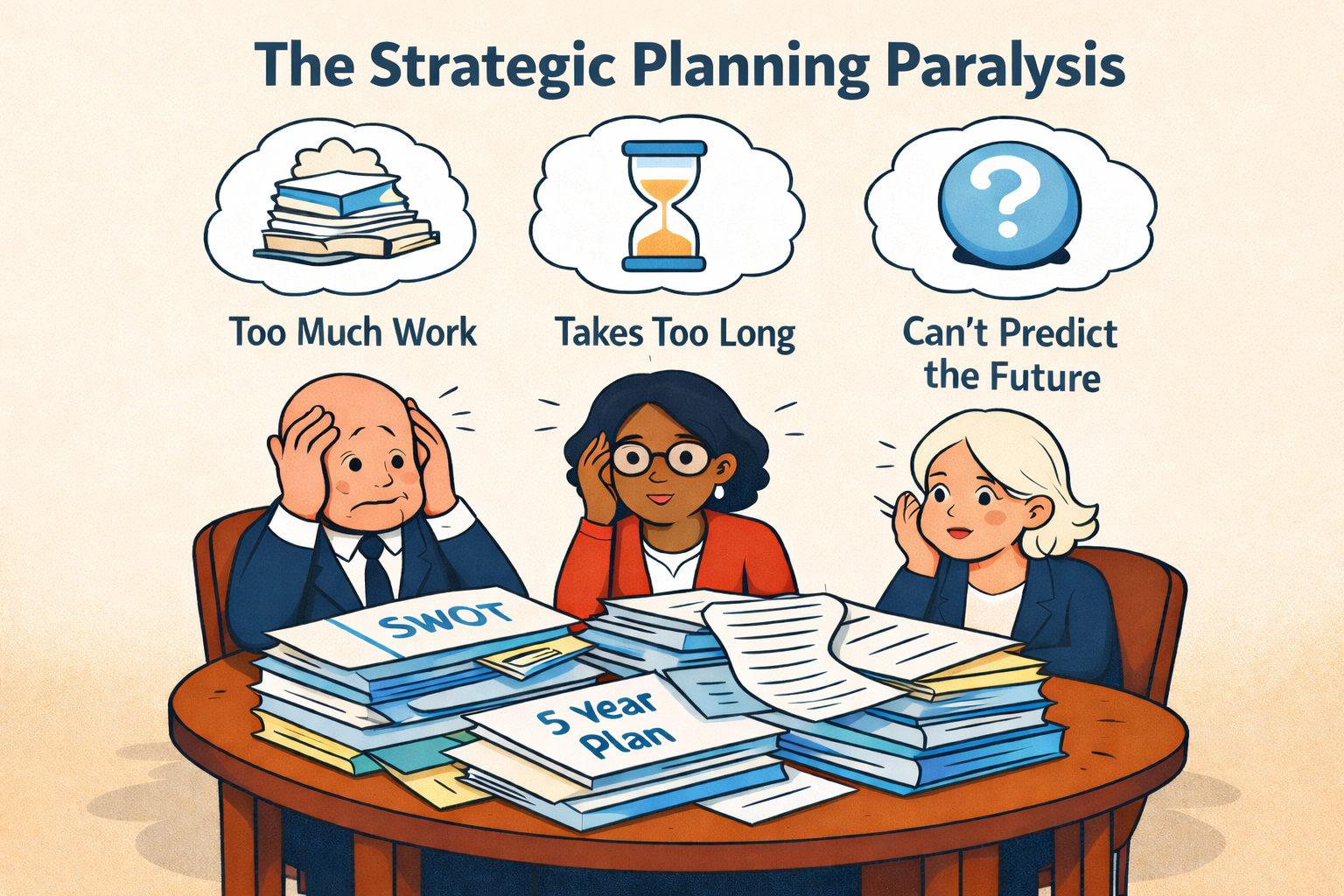
The Strategic Planning Paradox (When Seeking Clarity Becomes a Trap)
In the nonprofit world, strategic planning has got a bit of a sacred-cow status. We’re told that without a pristine three-to-five-year plan, our organizations will drift aimlessly into the void. But reality keeps interrupting. Hello?
You might be:
Navigating a leadership transition
Rebuilding after a forced organizational capacity reset
Operating in a funding environment that changes every six months
Sitting with a new or reconstituted board that’s still figuring out how to function
Responding to community needs that don’t politely wait for the planning cycle to end
In moments like these, the very tool meant to create clarity can do the opposite. It overwhelms. It delays decisions. It creates the illusion of control — while quietly stalling momentum. That’s not strategy. That’s paralysis dressed up as rigor.
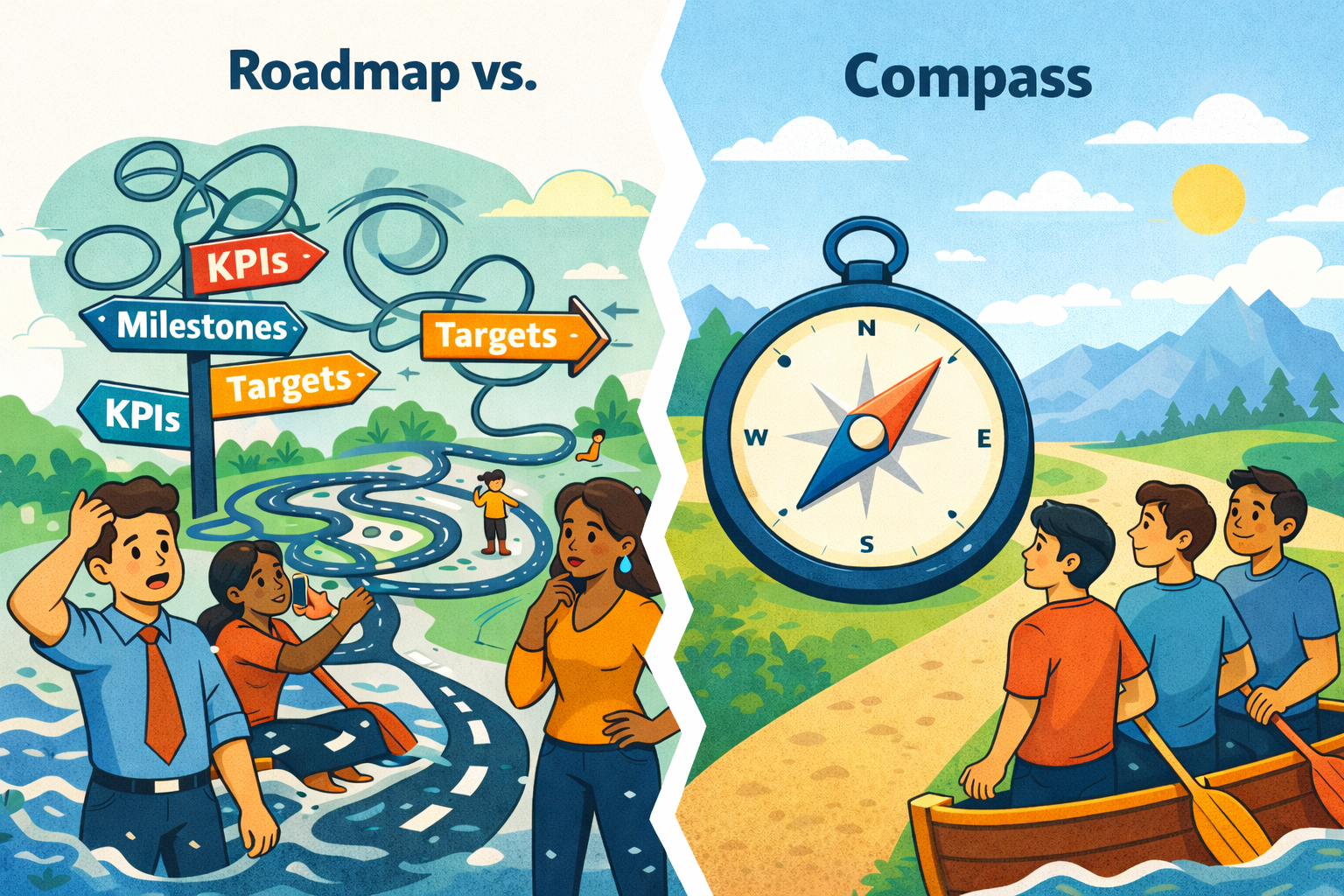
Roadmap vs. Compass
Enter the Guiding Narrative
A guiding narrative is not a mini strategic plan. It’s not a shortcut. And it’s definitely not a vibes-only exercise. A guiding narrative is a clear, shared story about where your organization is headed and why — one that your board can actually hold in their heads at the same time. Where strategic plans focus on goals, metrics, and milestones, a guiding narrative focuses on alignment:
Shared understanding
Emotional buy-in
A common frame for decision-making
Think of it this way: A strategic plan is a hyper-detailed roadmap with every turn labeled. A guiding narrative is a compass — it tells you which way is forward and trusts competent people to navigate.
What a Guiding Narrative Actually Answers
A strong guiding narrative doesn’t try to predict the future. It answers a smaller — and more powerful — set of questions:
Where have we been, really?
What moment are we in right now?
What challenge or opportunity can’t be ignored anymore?
What future are we actively trying to move toward?
What principles will shape our decisions along the way?
Who are we becoming as an organization?
Where do we invest our resources?
What are our non-negotiables?
If your board can answer those questions together, you’ve already solved half your governance problems.
When Narrative Beats Planning (Hands Down)
Guiding narratives shine in exactly the situations where traditional planning struggles most.
During uncertainty. When funding is volatile or the landscape is shifting fast, a narrative keeps everyone pointed in the same direction without pretending the future is predictable.
When capacity is tight. A narrative can be built in one or two focused sessions — not a week or months-long slog that drains staff energy and board goodwill.
When boards need to gel. New boards, merged organizations, or groups recovering from conflict often need shared understanding before they need tactics. Narrative creates coherence without forcing premature agreement.
When it's already going down. Sometimes you don’t need a new plan — you need everyone rowing in the same direction on the work already underway.
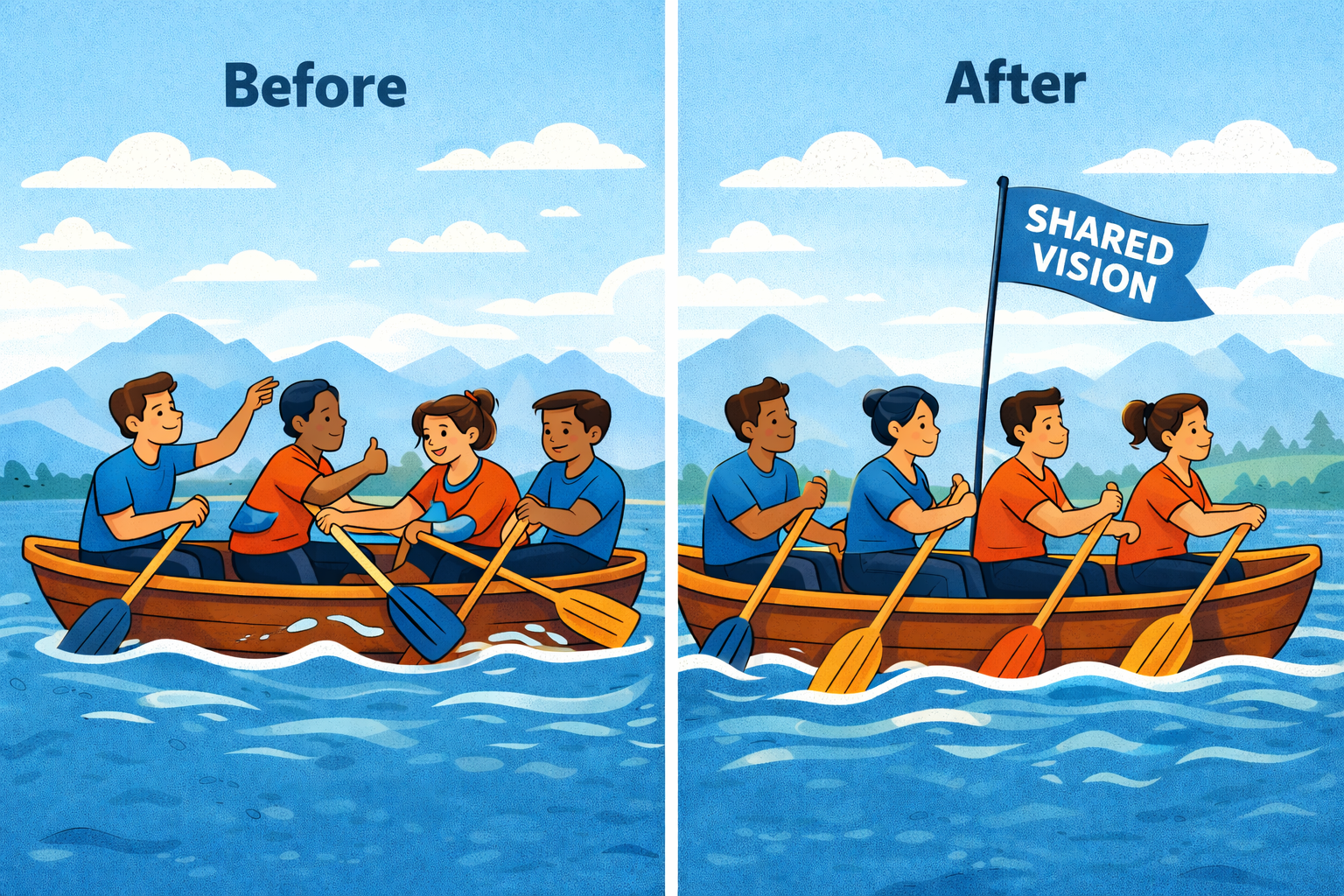
Alignment, not disconnect
What This Looks Like in the Real World
Take a youth mentoring organization that had been operating for 15 years. Their strategic plan had expired. Demand for services was exploding. Their founding executive director was planning to step aside. A new strategic planning process? Completely unrealistic. Instead, the board spent one Saturday building a guiding narrative. They landed on a very short guiding narrative:
For fifteen years, we’ve proven that long-term mentoring changes life trajectories. We’ve grown from serving 50 young people to 500 — and our waitlist is growing even faster. We’re at an inflection point: either we figure out how to scale with integrity, or we accept that we’ll keep turning young people away. Over the next few years, we’re choosing scale — not by watering down our work, but by building the infrastructure, partnerships, and funding required to serve three times as many young people without losing what makes our model powerful. That means evolving from a scrappy startup into a durable institution — and making some hard choices along the way.
No KPIs. No binders. Plenty of clarity. That narrative became the board’s decision-making filter — for hiring, fundraising, partnerships, and tradeoffs.
Or another example: a Black alumni association that's operated well enough for 50 years in a loose ad hoc way, dependent on university good will and supports, so much so that it's never really developed its own organizational muscle or infrastructure. Confronted with a higher ed environment in which Black student resources, inclusion and quality outcomes are threatened by the political climate, they have to evolve a functional autonomous organizational infrastructure......fast. How do you accomplish a quality planning exercise with a volunteer board of extremely busy people living across the entire country who meet twice a month virtually? infeasible. The chair developed a nine page guiding narrative that laid out the organization's story, its context and what that implied for the future and distributed it to the board along with a discussion guide to navigate a shared conversation about it. In two hours, the board achieved a level of alignment and shared understanding it would have taken at least a day or two of facilitated in person strategic planning to achieve.
Building a Narrative Without Fooling Yourself
This isn’t about avoiding hard thinking. A real guiding narrative still requires:
Honest assessment of what’s working and what isn’t
Clear-eyed conversation about constraints
Real consensus — not polite nodding
Start with your origin story. Why do you exist, and how has that evolved? Name the current moment honestly. This is where boards often dodge discomfort — and where the real value lies. Articulate direction, not precision. You’re choosing a trajectory, not locking in a spreadsheet. Define non-negotiables. These principles become your guardrails when decisions get messy. Finally, decide how you’ll know if you’re moving in the right direction — in broad, human terms.
The Limits (Yeah, There Are Limits)
Guiding narratives aren’t forever tools. They’re bridges. They work best over one to three years — especially during transition or uncertainty. Eventually, most organizations benefit from the discipline of formal planning. They’re also not ideal if:
You must choose between radically different futures
You’re executing highly complex initiatives that require tight operational choreography
Your board disagreements require structured conflict resolution
And crucially: A narrative written by staff or a board chair and simply rubber-stamped by the board is just another document. Engagement matters.
Making It Stick (This Is Where Its Gonna Live or Die)
A guiding narrative only works if it’s used. Board chairs should reference it when framing decisions. Staff should use it to explain priorities and resource needs. Board members should be able to tell it — in their own words — to funders and partners. Some boards revisit the narrative quarterly. Others open every board meeting with it. The point isn’t ceremony — it’s keeping the compass visible.
The Bottom Line
Strategic planning still has its place. When conditions are right, it can be powerful. But when time is tight, capacity is limited, or the future is murky, a strong guiding narrative can do what a plan often can’t: create real alignment, right now. The question isn’t “plan or narrative.” The question is: what does your organization need right now to move forward with clarity and confidence?
Sometimes, the smartest move isn’t a bigger plan — it’s a better story, shared deeply enough to guide real decisions and get down to business.
Think a guiding narrative might help you? Here's a template you can use to start your engines